

You're standing in a bakery in Rome. Or at a ticket counter in Tokyo — pick your favourite version. All you need is one simple question in English, and your mind is perfectly, completely blank. Which is strange, because last night, on your couch, you got that exact word right again and again in your flashcard deck. You felt fluent in your living room. The street had other plans.
If you've ever learned a language, we don't need to explain the feeling — our students describe it after almost every trip abroad: "But I knew it, I swear." And they did know it. Just not the way they thought. Psychology has a name for this: the illusion of competence. Below we'll show you what causes it — and which mechanism of SnappyCards, our own flashcard system, fixes which part of it. (The story of why we built the system is in the article where we first introduced it — today is about forgetting.)
What the illusion of competence actually is
In short: you're mistaking recognition for recall. On the couch, in the app's predictable little world, you don't actually retrieve the word — you recognise it. The card looks familiar, the letters look familiar, you may even remember it tends to come near the end of the deck. Your brain concludes: "I know this." But all that really happened is that you spotted the right answer once it was put in front of you.
In the bakery, nobody puts it in front of you. There you need the opposite direction: pulling an English word out of nothing, from a thought in your own language — with noise around you, a queue behind you and no time to think. That's a different task with a different load, and if you've only practised one direction, the other won't come by itself.
Why the couch flatters you
Two everyday mechanisms keep the illusion alive, and neither feels like cheating while it happens.
The first is habit. When round fifty is indistinguishable from round five — same card, same flip, same spot on the screen — your brain files the whole thing under "predictable" and quietly powers down. Psychologists call this habituation; you know it as the state where your thumb keeps flipping cards while you plan dinner. The hand is still studying. The attention checked out minutes ago.
The second is self-grading. Once the answer is on the screen, everything about it feels familiar — so you search for a moment, spot the solution, and rule in your own favour: I knew that. The deck records a success. The bakery, unfortunately, doesn't wait while you search.
Attention restart: no two rounds the same
SnappyCards' first answer to habit is to give it nothing to hold on to. There's no single card waiting in the centre: one or three cards spin up each round, in a different mix and order every time, and the moment you rate one, the whole row spins again. No two rounds are the same — your brain finds no pattern to settle into, so autopilot never switches on. We call this attention restart: instead of wearing out by the end of the deck, your attention resets round after round.
The half-asleep, dinner-planning flipping state simply cannot form. And with it, the first pillar of the illusion — that mechanical sense of familiarity — loses its footing.
You can lie to the button — not to your nervous system
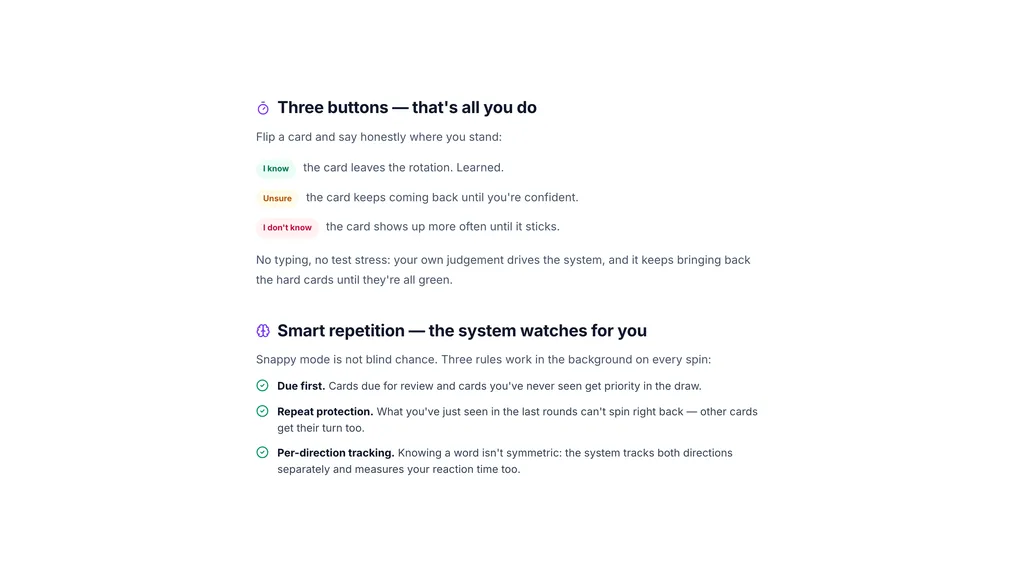
The second answer targets self-grading. You still rate yourself — three buttons: I know it, Not sure, I do not know. An I know it retires the card from the rotation, Not sure keeps it coming back until you're confident, and after I do not know it returns more and more often until it sticks. No typing, no test stress.
Nothing surprising yet. The point is the part you don't see: on every answer, the system clocks — to the millisecond — how long you took from the card appearing to your finger landing on a button. That changes everything, because your hesitation says more about your knowledge than the button you eventually chose. One I know it lands before you've finished reading the card; another arrives after a silent search you hope nobody noticed. Only one of those words will show up when you're mid-sentence.
So press I know it as generously as you like. You can lie to the button — you cannot lie to your own nervous system. Your reaction time doesn't lie: whatever you hesitated on comes back sooner, however "right" your final answer was. That principle of honesty runs through the whole system: we want your statistics to reflect genuinely focused learning, not minutes spent in front of a screen with your mind elsewhere.
Repetition timed to your forgetting curve
From that honest data, the system builds your schedule. Forgetting isn't a personal failing — it's how brains work. The only real question is when a word is worth meeting again. SnappyCards brings it back exactly when, according to your forgetting curve, the repetition is worth the most — not so early that you're bored of it, not so late that you'd be starting over.
Three simple rules run in the background. Due first: cards due for review, and cards you've never seen, get priority in the draw. Repeat protection: what you saw a moment ago can't spin straight back. And — the one that matters most for that Roman bakery — per-direction tracking. Recognising a word from English doesn't mean you can produce it going the other way, so the system tracks the two directions separately and measures your response time in each. You can't "learn" a word by knowing only its easier half. The full method is on the Snappy method page; the short version is that learning becomes 37% faster — and the knowledge lasts longer.
The goal is the same for every set: every card green. And when an old word fades — because it will — you can downgrade it any time, and the rotation picks up exactly where you need it.
Three habits that make it work even harder for you
Rate yourself strictly. Press I know it only when the word arrived instantly, with no searching — everything else deserves Not sure. Your reaction time will give you away anyway, but honest answers sharpen the scheduling. This isn't an exam; the clearer the picture, the harder the system works for you.
Don't dodge the harder direction. Going from your own language into English is always tougher than recognising the word coming the other way — but speaking happens in exactly that direction. When the harder direction comes up, don't treat it as a chore: that's what decides whether the word shows up at the counter.
Let the system do the timing. When a card returns and your first thought is "I already know this one", don't be annoyed — it's back for a reason: it was either due, or you hesitated on it last time. It costs half a minute, and that half minute is what keeps the word alive.
One more thing: this kind of learning thrives on short rounds that keep coming back, not the occasional marathon. We've written a separate article on fitting all of this into fifteen real minutes a day.
From the couch to the street
Let's say it plainly: flashcards alone won't teach you to speak. Between recognising a word, recalling it and saying it out loud there's one more flight of steps to climb — that's the subject of our article on getting from silent vocabulary to real speech, and it's why every lesson we teach is built around speaking. The cards' job is narrower: to make sure the words are within reach when you open your mouth.
If you study at Café English, SnappyCards is free for you — tell your teacher and you can start with the word sets from your own lessons. And if you don't study with us (yet), you can still try it: there's a free plan with the learning features included.
Next time a word runs flawlessly on your couch, ask yourself one question: did I recall that, or merely recognise it? If you're not sure of the answer, that's fine — your reaction time will tell you, down to the millisecond.
Try SnappyCards for free, spin your first deck, and see what your reaction time says about you.