

Once you start learning a language, the question arrives sooner or later: where do the new words go? Most of us walk the same three roads. First the notebook, where the words sit in neat rows and nobody turns back to them. Then the spreadsheet: tidy, searchable and just as motionless. Finally the translator app on your phone, opened mid-conversation and forgotten by morning. None of these is a bad idea — none of them is learning either: all three store, none of them tests you. And vocabulary grows precisely because something tests you.
Why flashcards work
A flashcard turns the situation around: you don't read the word, the word questions you. This is called retrieval: it isn't enough to recognise the answer in a list, your brain has to dig it out — and that effort is what makes the word stick. Re-reading is comfortable by comparison, and far less effective: the word feels familiar, but won't come when you need it.
The other half is timing. A word settles in for good when you meet it several times at widening intervals: today, tomorrow, three days later, two weeks later. A single long cramming session is the exact opposite.
Flashcards therefore work best in short bursts. Five to ten minutes a day beats an hour on Sunday evening — and that kind of study fits in your pocket: on the bus, in a queue, between two meetings.
The flipping trap
Work through a bigger deck and the feeling is familiar: you pay attention for the first ten cards, and by the twentieth you are just flipping. Not out of laziness. Brains tune out the predictable: when every round looks the same — word, translation, flip — they pay it less attention. You reach the last card with the satisfying sense of a session completed, and almost none of the vocabulary comes with you.
The second trap is self-assessment. Once the card is face up, you decide whether you knew it — but everything looks easy with the answer in front of you. And “I know it” on its own tells you very little: how quickly it arrived matters too. A word already on the tip of your tongue needs no more work; one you can only retrieve by first thinking the sentence through is not ready for live use yet.
What a good system measures
The first thing to look for is reaction time. If the system watches not only whether your answer was right but how long you hunted for it, it has a better picture of what you know — and brings the shaky words back sooner.
The second is direction. “house → ház” and “ház → house” are two different tasks: one is recognition, the other is retrieval. A good system tracks them separately, because speaking demands the harder direction.
The third is filtering: what you reliably know should drop out of rotation, so your five minutes a day go on the words that still don't come.
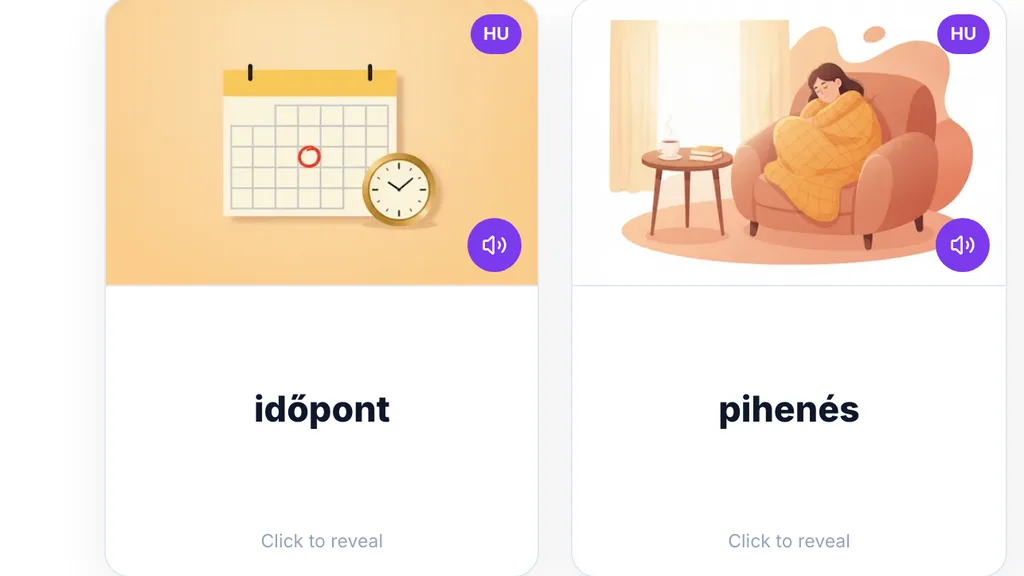
Tools like Quizlet are excellent at keeping your words in order; the difference is in the learning loop. That is why we built our own system, SnappyCards: it spins up one or three cards per round, measures your hesitation to the millisecond alongside your own rating, and schedules repetition from that. We wrote up why and how it was built in a separate article.
How to fit it into your day
The practical side is simple, but it has two pitfalls.
The first is volume. The most common mistake is starting with a thousand words, drowning by day three and never opening the app again. Start with ten to fifteen new words a week and spend the rest of the time revising.
The second is the source. Don't learn random word lists — learn what came up in your lesson or at work. Your own words carry context: you remember who said it and what it was about, and that context does half the work.
The time of day matters less than regularity. Attach it to a habit you already have: morning coffee, the commute, ten minutes after dinner. Miss a day and nothing happens; miss a week and restart with a smaller portion instead of catching up. If you study with us in a group, build a set from your lesson's words the same evening.
Flashcards are not magic: they won't teach you to speak, and they don't replace using the language. What they do solve is what they are for — keeping words from disappearing in the margin of a notebook. Start for free and see how much of it sticks over a week.