

It happens on holiday, in meetings, on the phone. Someone asks you a perfectly simple question in English — and you understand every word of it. You even know every word you'd need for the answer; you've seen them all a hundred times. And yet what comes out is a smile, a vague hand gesture and a quiet "erm… sorry." Ten minutes later the perfect sentence assembles itself in your head — beautifully, and uselessly.
We call this state silent vocabulary. The words are all there — just in the one form where they're worth the least: you recognise them when you see or hear them, but they won't come out when you need to say them. It's not laziness and it's not a lack of talent — just the natural result of how most of us study.
Recognising, recalling, saying: three different skills
When you say you "know" a word, you can mean three very different things.
The first is recognition: you see directions written down and the meaning clicks. It's the easiest level, and where most of our vocabulary lives, because most forms of study train exactly this. Reading, skimming word lists, subtitled shows, most textbook exercises — they all show you the word and ask you to recognise it.
The second is recall: you think of something in your own language and have to dig up the English word with no prompt in front of you. Much harder — there's nothing to lean on.
The third is saying it: the word not only assembling in your head but coming out of your mouth — out loud, recognisably, without a pause to think. This is a separate skill again. Your mouth, your tongue and your ears have to learn the word too, not just your memory.
The trouble is that most methods train the first skill, while conversation runs on the third. That's how you can study for years, understand nearly everything — and still go quiet at the moment you could speak. Why recognition feels like solid knowledge — and why "known" words vanish just when you reach for them — is a story we told separately.
The direction speech travels in
Of the three steps, flashcards are strongest at the second, recall: the card asks, and you have to produce the answer. But one detail decides a lot: direction.
English→your language trains comprehension — what you use when you read or listen. Your language→English trains recall, and speaking always runs that way: the thought is born in your language, but the sentence has to come out in English. The two aren't the same knowledge, and they don't grow together automatically — a word can be long since mastered in one direction while you're still hunting for it in the other.
That's why, when we built our own system, SnappyCards, one rule was in from day one: knowing a word isn't symmetrical. It tracks the two directions separately and measures your response time as it goes. The full story of why and how we built it is in our introduction to the system — the practical lesson here: for speaking, train the harder direction, from your own language into English. A few days will show you how wide the gap really is.
Say it out loud — every single card
Here's the step most learners skip, and it costs nothing: never study in silence.
Before you press I know it, Not sure or I do not know, say the answer out loud. Not in your head — audibly. Saying a word silently is like rehearsing a free kick in your imagination: useful, but not the same muscles. Said out loud, your mouth does the work and you hear your own voice speaking English — precisely the two things missing when a word gets stuck in a real situation.
The cards give you something to check against, too: listen to the pronunciation, say the word, then compare. The gift sets you receive on signing up have native pronunciation audio on both sides, and the AI can add natural-sounding audio to your own cards — a paid, credit-based extra, though for out-loud practice what comes with the free plan is enough.
Hearing your own voice speak English in your kitchen will feel odd at first. That's normal — and real speech begins on the far side of that oddness.
Q+A cards: practise as if you were already in the conversation
Saying single words out loud is the first step — but conversations happen in sentences. That's what the Q+A card is for: SnappyCards' dialogue-practice card type.
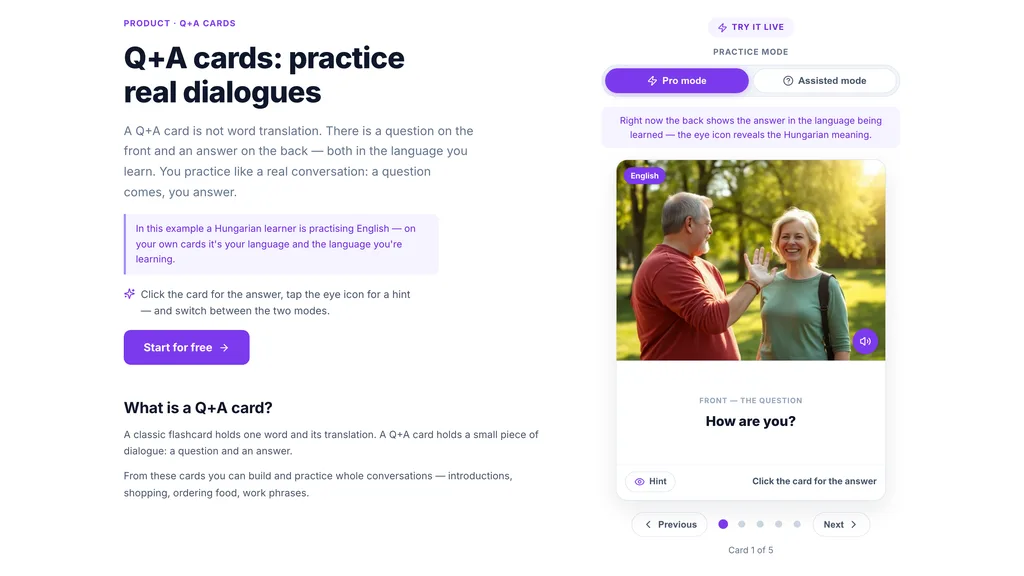
A Q+A card isn't word translation. There's a question on the front and an answer on the back — both in English. You practise the way conversation works: a question comes — How are you? — and you answer. In a full sentence, out loud, before you look at the solution.
From these you can build and rehearse entire conversations: introductions, shopping, ordering food, work phrases — even job interview questions and your own answers to them. Any question-and-answer material can become a deck: type the questions and answers in English, and the AI can translate the helper hints into your own language. Best of all, Q+A is available in every plan, including the free one.
Assisted mode or Pro mode?
You can practise Q+A cards in two modes, and the difference is a single thing: what you see first on the back.
In Assisted mode, the back first shows the meaning in your own language — the English sentence waits behind the eye icon: you say it first, then check. Choose it while you're still learning the sentences and need something to hold on to.
In Pro mode, the back shows the English answer straight away — Fine, thank you. — and the translation only appears from behind the eye icon if you get stuck. Choose it once you're confident and want to stay in English throughout.
Switching is a single toggle, so you move at your own pace: start in Assisted mode, and when you notice the sentence coming out of you before you press the eye icon, switch to Pro. That moment is exactly when silent vocabulary starts turning into real speech.
Situations you'll actually walk into
You don't have to write everything yourself: the ready-made gift sets in your account cover this ground. Some teach words, most teach full sentences you can use immediately — ordering in a restaurant or café ("I'd like to order."), staying at a hotel ("I'd like to book a room."), and yes, asking for directions in town ("How do I get to the station?"). Next time one of those questions finds you — on the street or on the phone — you'll have something to say.
None of this needs an afternoon set aside for studying: out-loud practice works best in short rounds. How to fit it into fifteen minutes a day is a topic with its own article.
What a card can't do — and doesn't need to
Let's be honest: a card doesn't talk back. It never asks a follow-up question, never mishears you, never changes the subject. The unpredictability of live conversation — the very thing that makes speech speech — is something no card can replace. It's not supposed to.
Its job is done earlier: by the time you're in the conversation, the words and sentences are already loaded — so your lesson is spent using English rather than searching for it. At Café English that's exactly how the two halves meet: what you've drilled out loud at home with the cards comes alive in class, in real conversation. And for our students SnappyCards is free, so the rehearsal and the live conversation are part of the same system.
Give your first deck a voice today — signing up to SnappyCards is free. And if you want those rehearsed sentences to hold up in real conversation, book a free consultation with us — we'll work out the best starting point together.