

Fifteen minutes a day: in all our years of teaching, nobody has ever told us that was too much. What we've heard instead, again and again, is that making the cards ate the evening. By the time you'd typed the words in from your notebook, looked up the translations and hunted down a picture or two, the evening was gone — and you hadn't practised a single word. SnappyCards — the flashcard system we ended up building ourselves — grew out of exactly that realisation: we didn't want to trim the learning at all, we wanted to remove almost everything around it.
The learning was never the expensive part
Think back over your own attempts. A quarter of an hour is nothing on its own: one coffee, one bus ride, one queue. What kills most vocabulary plans is step zero — having something ready to practise in the first place. As long as making cards counts as work, studying stays permanently filed under "tomorrow": the words stay stranded in notes apps and the backs of notebooks, and never become a deck.
So this article comes in two halves. First we take card-making off your plate; then we show you exactly where the fifteen minutes fit into an ordinary day.
Cards in minutes, without typing
If you have a word list anywhere — in your lesson notes, a Google Sheet, a Word file, even a PDF — then you already have cards: paste the list in, or upload a CSV, and your deck is ready. No typing line by line, no matching up pairs. Card entry takes up to 75% less time this way — and that's the whole point: the evening goes on practising, not on data entry. You don't have to abandon your old Quizlet decks either: their contents can be brought across too.
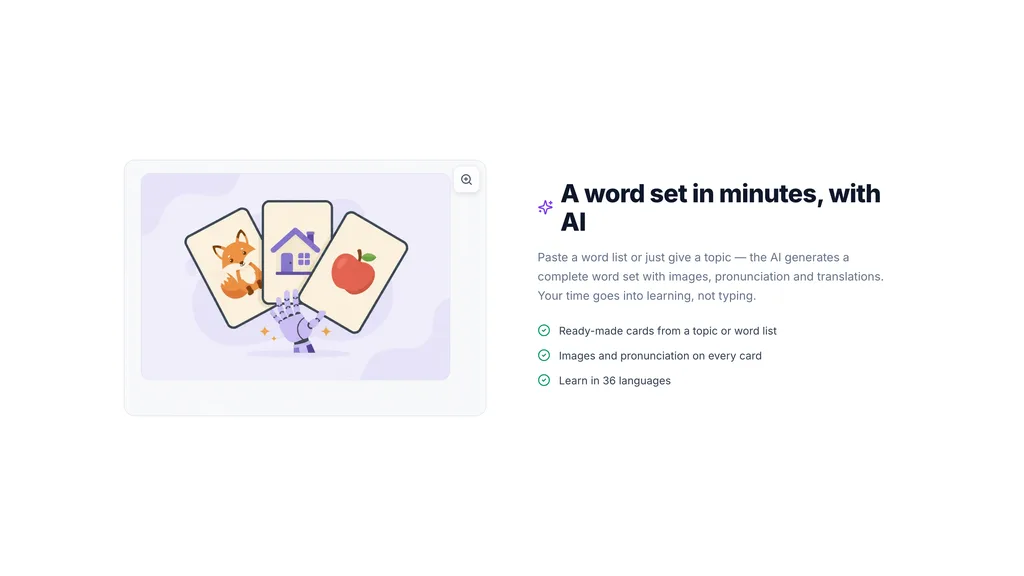
No list at all, just a topic — say "job interview" or "holiday"? The AI will build a complete set from a topic or a word list: images, native pronunciation, translations. To be clear: the AI features are paid, credit-based extras. Importing and editing cards by hand are free — so turning your own lists into study-ready decks costs you nothing.
You can start from zero — tonight
Two things mean you can begin without a list of your own.
First, the welcome gift: the moment you register, 20 ready-made Hungarian–English word sets are waiting in your account — 430 cards in total, with audio and pictures, none of them counting against your card quota, included in the Free plan as well. The first five decks teach words; the rest teach full sentences you can use as they are — in a restaurant, at a hotel, asking for directions. You don't start with an empty account: there's more than enough there for tonight's first quarter of an hour.
Second, the shop: browse professionally built sets, and you can sample five cards from any of them live before you buy. After purchase the set becomes your own copy — edit it, learn with it.
And to keep all of this within arm's reach: one tap installs SnappyCards on your phone's home screen — no app store, no downloads — and from then on it opens like any other app and picks up exactly where you left off. The full list of student features is collected on the students' page.
What the fifteen minutes actually look like
Don't picture one solid block — the beauty of this routine is that it never needs one. Here's the split we use with our students:
Morning, with your coffee — 5 minutes. Your hardest deck, while your head is still fresh. The cards spin up, you flip them and rate yourself with three buttons — I know it, Not sure, I do not know — and the system handles the rest.
Dead time during the day — 2–3 minutes, whenever it comes. On the bus, in a queue, between two meetings. Two minutes is enough for a round — which is exactly why the home-screen icon earns its place: dead time goes to your vocabulary instead of your news feed.
Evening — 5 minutes. Closing the day: whatever you were unsure about in the morning comes back around now. If several decks are on the go at once, you don't have to choose between them — you can practise them mixed together in a single session, and the switching doesn't confuse you; it keeps you awake.
Underneath, the system is watching what you hesitate on: shaky words return more often, and it doesn't waste your time on the ones you already know cold. Why a word comes back exactly when it does — and why the couch convinces you that you know words that then vanish in the street — is a story we tell in a separate article.
And one thing we can say because we built the system ourselves: we designed it so that the statistics flatter nobody — what we want the app to count is genuinely focused learning, not a screen left open on a desk. Your fifteen minutes should be fifteen real minutes.
Where the words come from
One extra five-minute slot a week completes the routine: on Sunday evening, paste in whatever the week brought you. Sunday's five minutes have one rule — only words with a story. If you can remember the lesson, the email or the meeting a word came from, that memory does half the retrieval work for you; a random list off the internet gives you none of that. Ten to fifteen new words a week is plenty — most of your quarter-hours should go on revision anyway.
One honest caveat, too: recognising a word on a card doesn't guarantee it will come out of your mouth in conversation. The road from recognition to speaking out loud — and how to practise full sentences with cards — is the subject of another article.
You can start tonight
There's a free plan, so starting tonight doesn't require a bank card. And if you study at Café English, SnappyCards is simply free for you — that's a commitment we've made. Why we felt we had to build a flashcard system of our own is a story we told in the announcement post; the short version: we wanted vocabulary learning to live where it counts — in your day, not on your to-do list.
Sign up for free, paste in your first list tonight, and spin it with tomorrow morning's coffee. Café English students: one word to your teacher and your lesson decks are assigned to you — all you have to bring is the daily quarter of an hour.