

English lessons are taught by native-speaking teachers in both private and group sessions. Our mentors, as we call them, don't speak any Hungarian at all, but don't worry. On the one hand, this is an attempt to create a native language environment that helps students to develop the ability to think in English. On the other hand, it provides the basis for authentic English language teaching.
For the most effective learning, we consider our matrix learning model to be the most ideal, which means that the student is given the opportunity to encounter English in different forms. Just like in real life. We have found that students who take advantage of private lessons, group lessons, speech practice sessions and participation in community events, have a faster rate of word retention and progress than students who learn only one way - say, in private lessons. The different types of activities complement each other well and are strongly mutually reinforcing. Therefore, the student reaches the level of his/her goal more quickly.

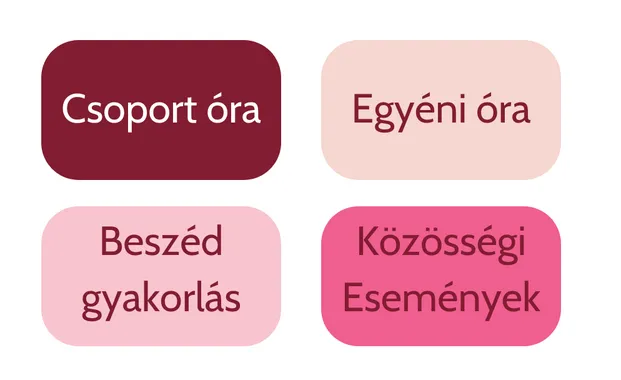
We have created four modules in our matrix. One of them is the „classic private lesson”, the group lesson, with a maximum of 5 students per group, but we also have two very important new elements. One is the speech practice session and the other is the community events.
If a student attends these informal classes with the same diligence as they would otherwise in formal education, they will learn English much faster than if they were to take private lessons.
Put another way. If a student has 100 hours of time and the necessary financial resources, he or she is most likely to make the most progress in the shortest time by using every opportunity in the matrix.
If we take five students, four of whom choose only one type of activity and the fifth student attends all types of lessons, the most successful student will be the one who has attended all four types of activities, i.e. 25 hours of private lessons, 25 hours of group lessons, 25 hours of speech practice and 25 hours of various community events.
This student has a significant advantage over the others, as he is immersed in learning English for life.
Of course, this is an ideal model. We understand that everyone has different opportunities and costs and that the hours and the learning matrix should be chosen according to the opportunities and constraints, in a way that best fits the student's life situation.
In order to ensure that our students get the most out of a given amount of time or budget, it is worth knowing what is the most effective learning model for them.

The matrix model offers Cafe English students several advantages in learning English. One of the most important advantages is that it provides a variety of learning opportunities, so that students can experience English in different learning formats, just as they would in real life. This model is perhaps the closest approximation to what it would be like to move abroad to learn a language. This model is based on a combination of private lessons, group English lessons, English language practice sessions and community events, all of which reinforce and complement each other.
The advantage for students is that they can develop their language skills in a holistic rather than a one-sided way. The mother tongue environment provided by native teachers helps to develop thinking in English and deepen language skills. The combination of different activities gives students the opportunity to practise the language in different contexts, which improves their ability to apply it in practice.
Cafe English's unique matrix model allows students to learn English faster and more efficiently, with less effort. Students who take advantage of the opportunities offered by the model reach their target language level more quickly because of the synergistic effect of the complementary types of activities. For example, private lessons allow for deeper understanding and personalised learning, while group lessons and social events help to develop communication skills.
This model is also flexible, as students can adapt participation to their own life situation and opportunities. The matrix model thus provides a comprehensive and adaptable learning framework that maximises language learning outcomes and experience.
 English (UK)
  Magyar